

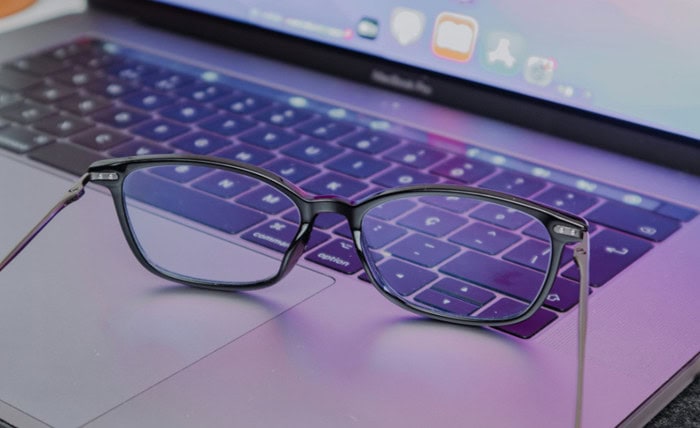
Most people think of blue light glasses as an evening habit, something to put on before scrolling a phone in bed. But the research that actually shows a measurable benefit points somewhere else: toward people whose sleep schedule doesn’t line up with daylight in the first place. That group includes night-shift workers, new parents managing overnight feedings, and travelers adjusting across time zones, and the underlying reason is the same for all three.
Why light timing matters more than light exposure
The body’s circadian clock is set largely by light, and it’s especially responsive to the blue-toned wavelengths found in both daylight and most digital screens. Blue light in the 460 to 480 nanometer range is the primary trigger for the retinal cells that signal the brain’s master clock to suppress melatonin, according to a 2025 systematic review and meta-analysis of randomized controlled trials on blue-light blocking glasses and sleep. For someone on a conventional schedule, that sensitivity barely registers day to day, since light exposure and sleep timing are already working together. The picture changes for someone whose schedule requires sleeping while it’s light outside or staying alert while it’s dark.
A comprehensive review published in Translational Vision Science & Technology looked specifically at where blue-blocking glasses show consistent benefit across the available studies. Of the interventions reviewed, seven were conducted specifically in shift workers, alongside studies in people with sleep complaints, sleep disorders, and even pregnant women managing disrupted sleep. The pattern across that research is consistent: benefit shows up most clearly in groups whose light exposure and desired sleep timing are working against each other.
What the shift-work research actually found
One of the more direct field studies, published in Chronobiology International, followed permanent night-shift workers at a Canada Post distribution center over several weeks. Workers wore blue-blocking glasses during their commute home and into part of the day, filtering wavelengths below 540 nanometers during the hours they needed to sleep despite daylight outside. Compared to their own baseline weeks, workers slept roughly half an hour longer per day on average, with improved sleep efficiency and less fragmented sleep.
That’s a modest but real, measured effect, tested against each worker’s own baseline rather than relying on general impressions. A separate randomized controlled trial published in Sleep Health reached a similar conclusion when comparing populations: healthy adults on a normal schedule showed little benefit from evening blue-blocking glasses, but the same review found good evidence supporting benefit in adults with sleep disorders, jet lag, or shift-work schedules specifically.
Where prescription lenses make this easier
For someone who already wears glasses daily, building blue light filtering into that same prescription is a simple way to apply this consistently, rather than needing a separate pair set aside for one specific window of the day. Eyebuydirect’s blue light glasses can be made with a standard prescription, which fits well here since the studies showing benefit involve consistent daily use during the relevant hours rather than occasional wear.
A less obvious group this extends to
New parents dealing with overnight feedings fall into a similar pattern. Older circadian research compiled in an overview of blue light studies has noted that light exposure during those middle-of-the-night wake-ups resets the same biological clock a night shift would, and that reducing blue-toned light during those feedings, through dimmer lighting or blue-blocking glasses, may help protect the parent’s own sleep afterward.
Jet lag follows the same underlying logic. The TVST review found that several of the studies showing benefit paired blue-blocking glasses with intentional bright light exposure during waking hours, suggesting the glasses work best as part of a broader approach to resetting light exposure around a shifted schedule, rather than as a single fix on their own.
The takeaway
The common thread across shift work, overnight parenting, and travel is straightforward: when someone’s sleep needs to happen out of step with natural daylight, managing light exposure during the wrong hours has real, measured research behind it. For anyone in one of these situations, that’s a genuinely useful application, and one that’s easy to build into glasses someone is already wearing every day.